
Endeavor Jordan had its first local selection panel on Monday. This is the process whereby Endeavor Entrepreneur candidates are vetted by a local panel of top business leaders to determine if they should present at the Endeavor International Selection Panel (ISP), held four times per year. The next Endeavor ISP will be held here in Jordan at the Kempinski Hotel, Dead Sea. This ISP will also mark the official launch of the Endeavor Jordan office - go Jordan!
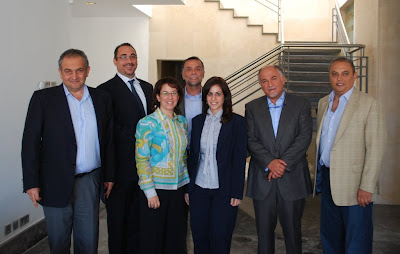
Our panel consisted of the top business leaders in Jordan. They include, from left to right: Ali Al-Husry, former Chairman and CEO of Capital Bank and Chairman of Endeavor Jordan; Laith AL-Qasem, CEO of Arab Business Consultants for Development; Fadi Ghandour, Founder and CEO of Aramex and Endeavor Jordan Board Member; Maher Kaddoura, MD Huron Consulting Group; and Safwan Masri Professor at Columbia Business School and Endeavor Jordan Board Member. In the front you'll find Endeavor Jordan Managing Director Carmen Saad and me of course! These guys are very busy. As Fadi Ghandour tried to hurry out of the meeting, I intercepted him and asked that he pose for a proper group picture. Thankfully, he's a very nice guy and happily obliged.
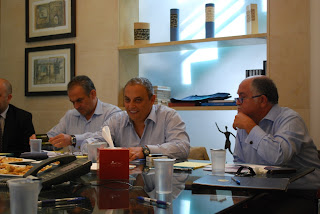
It was an exciting day of entrepreneurs presenting to the panel, great discussion and (sometimes) heated deliberation. The event spurred my thinking again about the state of entrepreneurship in Jordan and the level of sophistication among both entrepreneurs and capital providers. I must say the search and selection team put together quite an inspiring and varied group of entrepreneurs.
Our panel consisted of the top business leaders in Jordan. They include, from left to right: Ali Al-Husry, former Chairman and CEO of Capital Bank and Chairman of Endeavor Jordan; Laith AL-Qasem, CEO of Arab Business Consultants for Development; Fadi Ghandour, Founder and CEO of Aramex and Endeavor Jordan Board Member; Maher Kaddoura, MD Huron Consulting Group; and Safwan Masri Professor at Columbia Business School and Endeavor Jordan Board Member. In the front you'll find Endeavor Jordan Managing Director Carmen Saad and me of course! These guys are very busy. As Fadi Ghandour tried to hurry out of the meeting, I intercepted him and asked that he pose for a proper group picture. Thankfully, he's a very nice guy and happily obliged.


It was an exciting day of entrepreneurs presenting to the panel, great discussion and (sometimes) heated deliberation. The event spurred my thinking again about the state of entrepreneurship in Jordan and the level of sophistication among both entrepreneurs and capital providers. I must say the search and selection team put together quite an inspiring and varied group of entrepreneurs.
Sitting in the room with the panelists, hearing them joke with each other and interrupt the entrepreneurs to ask incisive questions, I felt like I was sitting around the board room with the partnership at my old venture fund:
"How do you quantify your target addressable market?"
"Your greatest risk lies in successfully executing on your franchising strategy."
"What is your pricing model and how will you work to build your recurring revenue base?"
"How do you quantify your target addressable market?"
"Your greatest risk lies in successfully executing on your franchising strategy."
"What is your pricing model and how will you work to build your recurring revenue base?"
The entrepreneurs were quite impressive as well. They brought energy, charisma, shiny power point presentations, and well thought out responses to the panelists' questions.
The entrepreneurs included a female PhD who founded a profitable social enterprise, the creators of a very innovative new green technology, a couple of Web 3.0 gurus, and a niche retail specialist who has grown a sizable business already. We're very excited to see who makes it through the ISP to become an Endeavor Entrepreneur. Stay tuned to this blog - I'll announce the new Jordan Endeavor Entrepreneurs in October!
The entire experience made me think: "Yes, Jordan is ready. The seeds have been sown to grow a strong knowledge-based economy built on entrepreneurship."
How does Endeavor help?
The entire experience made me think: "Yes, Jordan is ready. The seeds have been sown to grow a strong knowledge-based economy built on entrepreneurship."
How does Endeavor help?
First, Endeavor provides access to a network of top business leaders. In addition to 3 of the panelists mentioned above, Endeavor has Samih Darwazeh, Founder of publicly traded Hikma Pharmaceuticals on its board, as well as Peter Kellner, co-Founder of Endeavor. The office has also assembled a group of VentureCorps members, other business leaders who serve as mentors to the entrepreneurs. Endeavor provides consulting/mentorship, makes introductions to potential partners, customers and funders, and can provide training on raising capital and pitching to investors.
Endeavor seeks the entrepreneurs with high potential and gives them a bit of a push, or a shoulder to stand on, in order to ensure their success. In this way, the organization helps build large companies that can employ many people and helps build a culture of entrepreneurship that encourages others to achieve. Endeavor entrepreneurs give back by coaching others and in some cases donating a portion of their revenue.
Endeavor seeks the entrepreneurs with high potential and gives them a bit of a push, or a shoulder to stand on, in order to ensure their success. In this way, the organization helps build large companies that can employ many people and helps build a culture of entrepreneurship that encourages others to achieve. Endeavor entrepreneurs give back by coaching others and in some cases donating a portion of their revenue.
A key question in my mind is: How much of a role does Endeavor play in the entrepreneurs' success? Would these entrepreneurs be as successful without Endeavor's help? I'll come back to this in a later post. But the short answer is, I think Endeavor does have a unique and important role to play.
Finally, here's a quick tour through our office:
 Modern set-up.
 Beautiful views.
 Outside garden. We have 3 undergraduate interns (in suits), me (also in a suit), Ismail and Ali (search and selection team, Ismail on the left), and Carmen (managing director, center).


